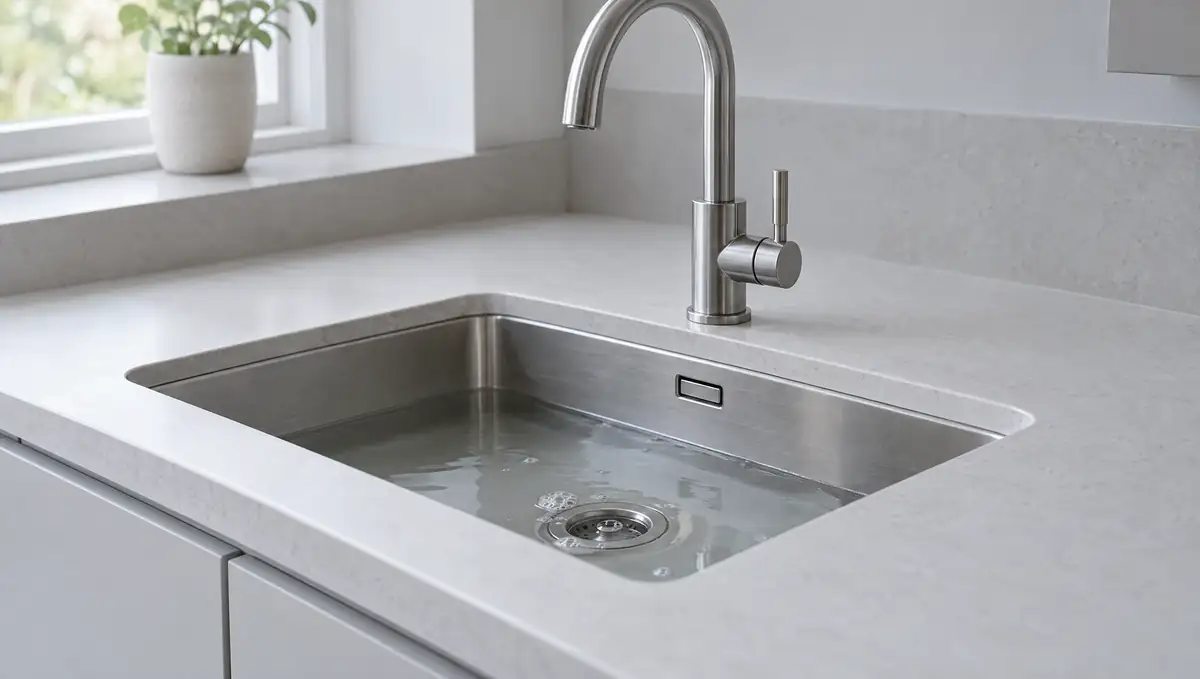
A drain rarely fails without warning. In the days or weeks before a sink, floor drain, or toilet backs up completely, it usually sends a series of smaller signals. Learning to read them means the difference between calling for a quick clearing and dealing with a flooded bathroom or kitchen at the worst possible time. The following signs matter in any home or building across Kuwait, whether the line runs under tile, through a courtyard, or out to the street connection, and none of them require any special knowledge to notice, only a bit of attention to how a drain normally behaves.
Slow draining is the first signal
Water that once disappeared from a sink or shower in a few seconds now lingers before it goes down. This is usually the earliest and easiest sign to miss, because the water still drains eventually and it is tempting to assume nothing is wrong. Inside the pipe, grease, soap residue, hair, and fine debris build up along the inner wall over time. The opening at the centre of the line narrows gradually, so flow slows down long before it stops. A drain that used to be fast and is now sluggish is telling you the internal diameter has already shrunk. The change is often so gradual that it only becomes obvious when compared with a similar fixture elsewhere in the same home that still drains quickly.
Gurgling sounds mean trapped air
A gurgling or bubbling noise from a drain, especially one that happens when a different fixture is used, is air escaping past a partial blockage. Every drain line relies on a steady, unobstructed path for water and air to move together. When debris narrows that path, air gets trapped and pushed back up through the water seal in unpredictable bursts, which is what produces the sound. A single gurgle after heavy use might be nothing. A gurgle that repeats every time the washing machine empties or the toilet flushes is a sign the line downstream is already restricted, and the sound will usually get louder and more frequent as the restriction grows rather than fading on its own.
The smell that should not be there
Every fixture has a trap, the curved section of pipe that holds a small amount of water and blocks sewer gas from rising back into the room. A persistent bad smell near a drain usually means one of two things: the trap has dried out from disuse, or waste is sitting and decomposing behind a partial blockage instead of moving through the line as it should. If running water for a minute does not clear the smell, the second explanation is more likely, and it points to buildup rather than a dry trap. A smell that keeps returning after cleaning the visible part of the fixture is a strong hint that the actual cause sits further down the line, out of reach of any surface cleaning.
Water rising in a second fixture
One of the clearest signs of a real blockage, rather than a minor slowdown, is when using one fixture affects another. If flushing a toilet causes water to rise in a nearby shower drain, or running the kitchen sink causes gurgling in the bathroom, those fixtures share a section of line, and something downstream is already restricting flow for both. This is not a coincidence and it will not resolve itself.
It means the shared line has a blockage forming between the fixtures and the main run, and it will only get worse with continued use. In a villa or apartment building, this kind of cross reaction between fixtures on different floors or in different rooms is often the first clear proof that the problem sits in a shared section rather than in a single drain.
Recurring plunging is a pattern, not a fix
A plunger clears the symptom in front of you, not the cause behind it. If the same drain needs plunging every week or two, the underlying buildup is still there and simply reforming after each use. At that point it is worth understanding the three real ways a blocked line gets cleared, because a plunger only ever addresses the last few centimetres of pipe, while the actual restriction is often much further down the line.
What a camera inspection actually shows
Before deciding how to clear a line, it helps to see what is inside it. A CCTV camera passed through the drain shows exactly where the buildup sits, how severe it is, and whether the pipe itself is intact or damaged. This turns clearing from a guess into a targeted job, and it is also how a technician can confirm afterward that the line is genuinely clear rather than just flowing again for the moment.
Seeing the footage also settles any doubt about whether a blockage is a simple buildup of grease and debris or something more structural, such as a joint that has shifted or a section of pipe that has cracked. The same camera approach is unrelated to hidden water leaks, which show up differently and are found through listening and isolation rather than drain clearing.
If any of these signs are showing up now, slow draining, gurgling, odour, or water rising in a second fixture, the line is already restricted even if it has not overflowed yet. Waiting rarely improves the situation, and a blockage found early is almost always simpler to clear than one that has already backed up, since the buildup has had less time to spread further along the line or harden against the pipe wall. A look at the plumbing and drain services available across all six governorates is a reasonable next step, and a camera inspection before any work begins means the exact location and cause are known before anything is touched.