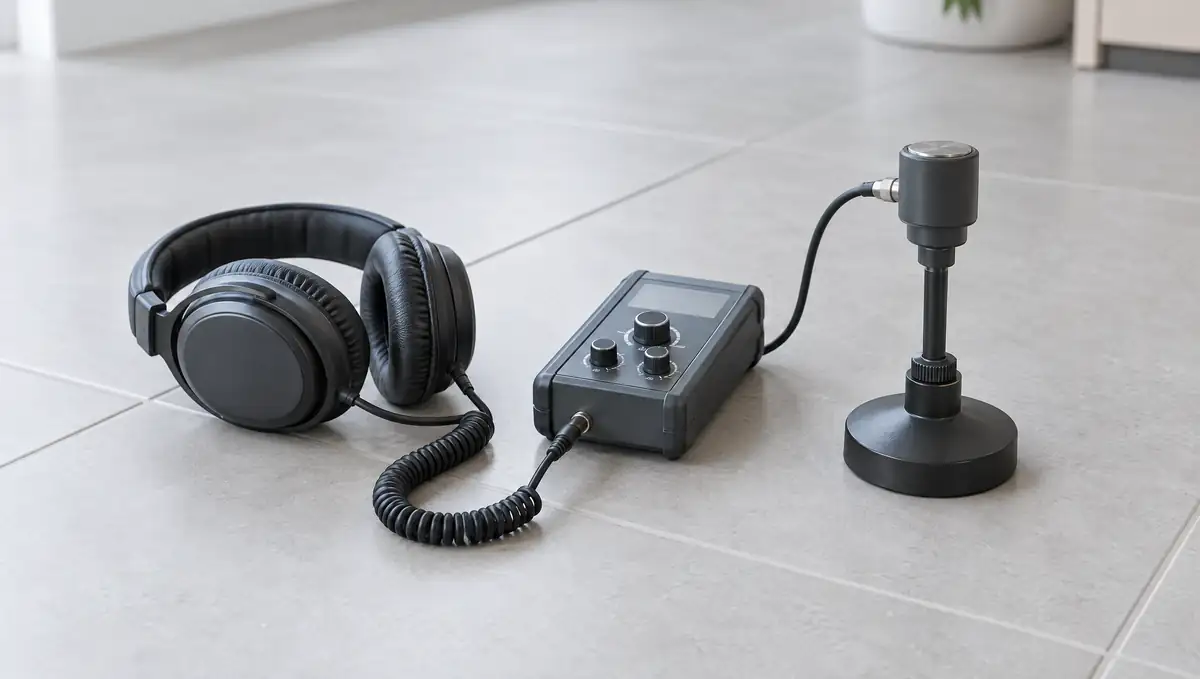
A leak inside a wall or under a floor rarely announces itself clearly. It shows up as a damp patch that will not dry, a section of tile that feels slightly warm or cool compared to the rest of the floor, a water bill that keeps climbing without an obvious reason, or a faint hissing sound in an otherwise quiet room. The instinct is often to start breaking tiles near the suspected area to find the pipe, but that approach is a last resort, not a starting point, because a hidden leak can be traced with a fair degree of accuracy before anything is opened up. A methodical search, done in the right order, almost always costs less in the end than an educated guess at the wall.
Listening for the leak acoustically
Water escaping under pressure through even a small crack in a pipe makes a sound, and that sound travels through the pipe material and the surrounding structure far beyond the actual leak point. Acoustic listening equipment picks up that sound through walls and floors, and a technician moves the listening point around the suspected area, comparing how loud and how clear the sound is at each spot.
The leak is loudest and sharpest closest to its source, so this process narrows a search area down to a much smaller zone before any tile is touched. It is precise enough, in most cases, to identify a specific section of floor or wall rather than an entire room. Background noise from traffic outside, air conditioning, or nearby appliances can make this harder, which is one reason a quiet period in the property helps the listening equipment do its job properly.
What a camera inspection adds
A CCTV camera is more useful for drain and sewage lines than for pressurised water supply lines, since supply pipes are usually too narrow and are not designed to be entered by a camera head. Where a camera does help with leaks is in confirming the condition of any accessible section of pipe, checking a drain line for damage that might be allowing water to escape into the ground around a foundation, and ruling out a blocked or damaged drain as the actual source of dampness rather than a supply leak. Between acoustic listening and a camera where the line allows it, most of the guesswork about location is already removed before any physical search begins.
Checking the meter confirms whether water is being lost at all
Before searching for where a leak is, it helps to confirm that one exists. Shutting off every tap, appliance, and fixture in the property and then watching the water meter is a simple check. If the meter continues to register usage with everything closed, water is escaping somewhere in the system between the meter and the fixtures. This step does not locate the leak, but it confirms the problem is real, gives a rough sense of how much water is moving, and rules out the possibility that a high bill is coming from somewhere else entirely, such as a fixture left running or a tank overflow.
Isolating sections narrows the search further
A property's water supply is rarely a single continuous pipe. It runs through sections that can often be shut off independently, one bathroom at a time, one floor at a time, or one branch line at a time. By closing off sections one by one and rechecking the meter or listening again after each, it becomes possible to confirm which branch of the system the leak sits on before narrowing further within that branch.
Combined with acoustic listening, this is usually enough to bring the search down to a specific short run of pipe rather than an entire floor or wall. In a larger building with several units sharing a main supply, this same isolation process is also what separates a leak on one tenant's own line from a leak on a shared section that affects several units at once.
Why guessing and breaking is the expensive route
Opening tile without this groundwork means searching blind, and a hidden leak is not always directly under the first damp patch that appears, since water travels along the easiest path before it shows up on the surface. Breaking in the wrong spot means a hole that finds nothing, a repair to that tile regardless, and the leak still not found.
Every one of the steps above, listening, camera inspection where relevant, meter checks, and isolating sections, exists specifically to avoid that outcome, and together they usually pin down a leak closely enough that only the actual repair point needs to be opened. This is also a different kind of job from a slow or blocked drain, and the tools used to clear a line, described in how jetting, a machine, and a snake are chosen, do not apply to a pressurised leak at all.
If a bill is rising without explanation or a damp patch will not go away, an inspection before any tile comes up is the sensible order of operations. The plumbing and water heater services available across Kuwait include this kind of leak detection, and finding the source first is what keeps the eventual repair small and specific rather than a search across an entire room.