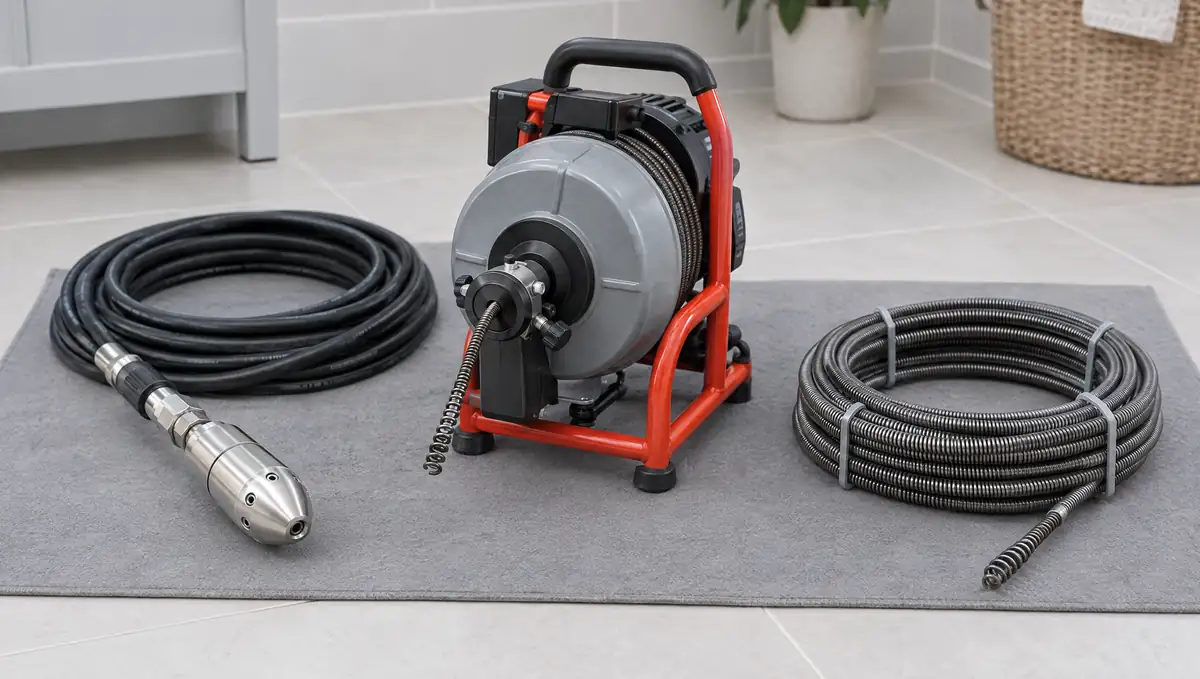
When a drain stops flowing properly, there are three different tools that might be used to open it back up, and each one solves a different kind of problem. Reaching for the wrong one at the outset either fails to clear the line properly or costs more time than necessary. Understanding what each method actually does inside the pipe makes it easier to know what to expect when a technician arrives, and why the choice is rarely arbitrary. The three methods are not interchangeable substitutes for each other, they are matched to the material causing the blockage and to where in the system that blockage sits.
High pressure jetting washes the entire wall of the line
Jetting uses a hose that sends a strong stream of water through a nozzle at the end, moving through the line and cleaning the full inner wall of the pipe rather than just breaking a path through the centre. The nozzle usually has jets facing both forward and backward, so it pulls itself through the line while blasting grease, soap buildup, sludge, and fine debris off the pipe walls as it goes.
This matters because a blockage that is only punched through in the middle will build back up quickly, since the layer coating the rest of the pipe is left in place. Jetting is the method that actually restores a line closer to its original internal diameter, not just its ability to pass water for now. It is the right choice for grease buildup in kitchen lines, general sludge in a main run, and any pipe where the walls themselves are coated rather than just having a single hard obstruction.
A machine breaks up heavy blockages and roots in main lines
A drain machine, sometimes called an auger, uses a rotating steel cable with a cutting head to physically break apart solid blockages and cut through roots that have grown into a main line from outside. This is a different job from jetting. Where jetting cleans and flushes, a machine cuts and drills through something that is genuinely obstructing the pipe, most often tree roots that have found their way into a joint in an older or damaged section of line, or a solid clog that water pressure alone cannot move.
Main lines that run underground between a building and the street connection are the typical place a machine is used, because that is where roots are most likely and where the pipe diameter is large enough for the cable to work effectively. Once the cable has cut a clear path through, jetting is often brought in afterward to remove whatever coating and debris the cutting action left behind on the walls, since a machine on its own opens a channel rather than cleaning the full surface of the pipe.
A drain snake handles narrow runs inside the house
A drain snake is the smallest and most precise of the three, a flexible cable fed by hand or a small hand crank directly into a sink, shower, or toilet line. It is built for the narrow pipes inside a house rather than the wider main lines outside, and for blockages sitting close to a fixture rather than deep in the system. A snake is the right tool for hair caught in a shower drain, a toy or object lodged in a toilet, or a localised clog just past a sink trap.
Pushing a full jetting hose or a heavy machine cable into a line that small either does not fit or risks damaging a pipe that was never built to handle that kind of force. Because a snake works on a single, short, visible section of pipe, it is also usually the fastest of the three methods when the blockage genuinely is close to the fixture rather than further along the line.
Why a camera inspection decides which one is used
Choosing between these three without first seeing inside the line is guesswork. A CCTV camera passed through the drain shows exactly what is causing the restriction, whether it is a coating of grease along the walls, a root intrusion at a joint, or a solid object stuck near a fixture, and how far into the line it sits.
That single piece of information is what tells a technician whether jetting, a machine, or a snake is the right tool, and it is the same inspection that confirms the line is genuinely clear once the work is done rather than just flowing again for the moment. Homeowners who notice the early warning signs of a blocking drain before a full backup happens give a camera inspection the best chance of catching the cause early, while it is still a simple fix.
When methods are used together
These three approaches are not always separate choices. A main line with heavy root intrusion might need a machine to cut through the roots first, followed by jetting to clean the remaining wall coating so the line does not clog again within a short time. A narrow inside line is more likely to need only a snake. None of this overlaps with a hidden water leak, which is a different kind of problem entirely and is found through listening and isolation rather than any of these clearing methods.
If a drain is not responding to a plunger or basic clearing attempts, the next step is a camera inspection rather than guessing at which tool to try next. The plumbing and drain services covering all six governorates include this kind of assessment before any clearing work begins, so the method used actually matches what is blocking the line.