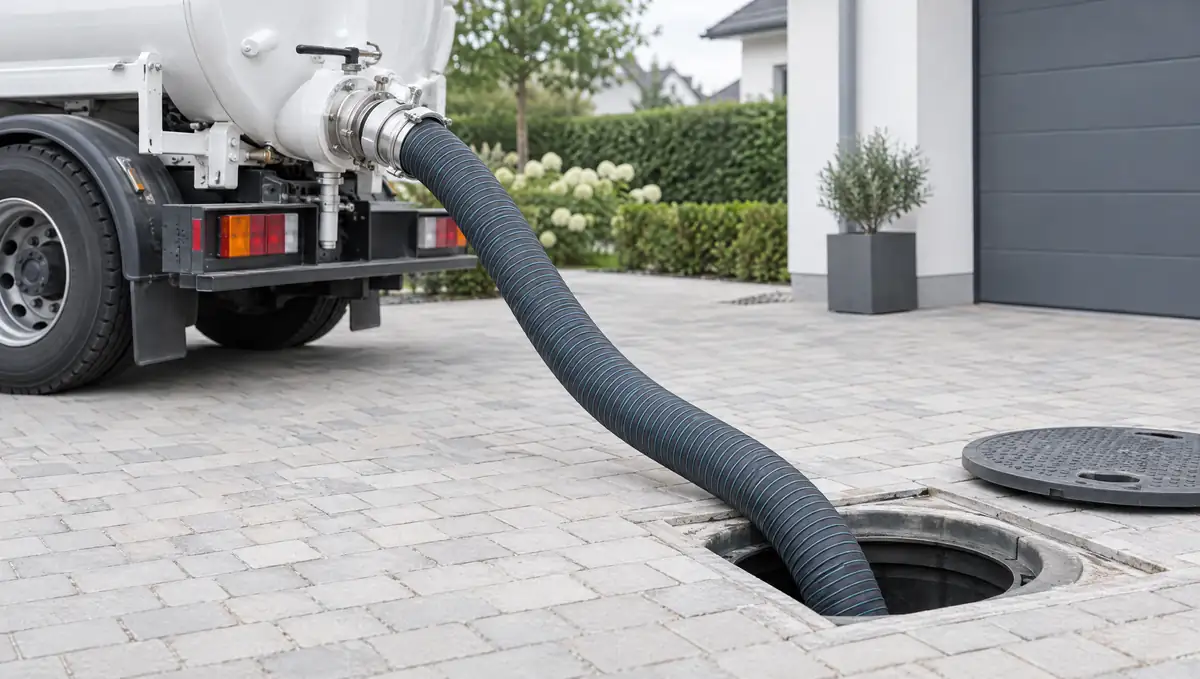
A cesspit or basement sump that has caused no trouble in months can turn into an emergency within days, and the warning signs are almost always there before the first overflow. Learning to read them, understanding what makes one pit fill faster than another, and knowing what the suction work actually involves lets a homeowner or building manager plan around the problem instead of reacting to it.
Signs a pit is close to full
The most reliable sign is timing, not smell. If the interval between suction visits keeps shrinking, from what once passed a season to something closer to a few weeks, the pit is filling faster than before and something upstream has changed. Slow drainage across the whole property, rather than in one bathroom, is another clue, because it points to the pit itself rather than a single blocked branch line.
Gurgling from floor drains or toilets after a shower or a washing machine cycle often means the pit is near capacity and pushing air back up the line as water tries to enter. A damp patch or soft ground near the pit cover, especially after normal household use rather than heavy rain, usually means it has already started to seep before reaching a full overflow.
What makes a pit fill faster
Household size and habits matter more than the size of the pit itself. A property that added tenants, a home business, or a larger family without changing its waste system will see the pit fill on a shorter cycle than the one it was designed around. Grease and cooking oil poured down a kitchen sink do not break down in a cesspit the way they would in a treatment plant, they settle and reduce the usable volume over time, which is one reason kitchen drainage in restaurants behaves so differently from a home, as covered in why commercial kitchen lines need their own maintenance routine.
Groundwater intrusion through a cracked pit wall or a poorly sealed cover adds volume that has nothing to do with household use, and it usually shows up as a pit needing emptying on a shorter and shorter cycle even though nobody in the house has changed their habits. Soil type plays a role too, ground that drains poorly around the pit slows the natural seepage a cesspit relies on and effectively behaves like a smaller pit.
Why an overflow repeats itself
A pit that has overflowed once is more likely to do it again, and not by coincidence. Solids that reach the point of overflow are usually pushed toward the outlet or the surrounding soil, which narrows the effective capacity even after the liquid level drops back down. The event itself is also a signal that the emptying interval in use was already too long for how the property is actually being used, and without adjusting that interval the same conditions build up again on roughly the same timeline.
Waiting for the next visible sign, rather than setting a fixed schedule based on the property's actual usage, is why so many overflows repeat in the same pattern. A fixed schedule, checked and adjusted after the first year of use, is the only real way to stay ahead of it.
What the suction work involves
Proper emptying starts with access, the cover is opened and the contents are inspected before anything is pumped, because a pit that is unusually full, unusually dry, or shows signs of an outside water source needs a different approach than a routine visit. A vacuum tanker draws out the liquid and settled solids through a hose, and a thorough job includes breaking up compacted material at the base rather than only removing what pumps out easily, since leftover solids are what shortens the next interval.
Where the property allows it, a camera pass through the connecting line confirms there is no separate blockage feeding into the pit, which matters because a line that looks clear from a visual overflow can still be constricted further down, the same logic behind checking what causes a drain to start smelling of sewage rather than just masking it. Once the pit is emptied, a quick check of the cover seal and the surrounding ground is worth doing while the crew is already there, since a loose seal is one of the easier problems to fix before it becomes a bigger one.
Setting a schedule that actually works
The right interval is specific to the property, not a number borrowed from a neighbor's house. It depends on how many people use the system, whether there is a kitchen or laundry load feeding into it, the soil around the pit, and the pit's own condition. A camera inspection before and after a suction visit gives an honest picture of where things stand without guessing, and a company working across all six governorates should be able to compare what is typical for the local soil and building type. Services covering suction, camera inspection and general drain work are outlined on the services page for anyone setting up a first schedule.
If a pit has already overflowed once, or the interval between visits keeps getting shorter, it is worth having it inspected before the next event rather than after. A short visit with a camera and a vacuum tanker is far less disruptive than a flooded yard or a backed up ground floor.